Showing posts with label insurance. Show all posts

Wednesday, March 26, 2014

Sebelius v. Hobby Lobby- A Guess

Today the Supreme Court continued to hear oral arguments regarding the case Sebelius v. Hobby Lobby. While the case has many facets, the crux of the dispute concerns whether it is constitutional for the government to require a for-profit business to violate their religious conscience by providing their employees with health insurance that pays for all types of contraception (even contraception that potentially terminates a fertilized egg.)


 I don't think that the importance of this case can be overstated. I'm linking to several articles below that aptly discuss the implications of this case for the religious community and for constitutional freedoms at large. My goal today is to flesh out a few guesses regarding how the Supreme Court will decide this case.

I'm no constitutional scholar and these are merely guesses, but hopefully this exercise will help us to view the case from multiple vantage points, thereby creating a more robust understanding of the issue.


Disclaimer- While we can postulate about the outcome of the Sebelius v. Hobby Lobby case, it is important to remember that the Supreme Court often has a mind of its own. One notable example is their objection to the government leveling a fine for not having health insurance and then suggesting that calling it a tax would be acceptable. That makes complete sense.

Option #1: An Obama Administration Victory


The Supreme Court could very well side with the Justice Department and argue that since the ACA (Affordable Care Act) is not specifically targeting religious organizations, the law is valid and Hobby Lobby must provide the same level of health insurance to its employees as any other for-profit business operating in the United States.

I am skeptical about the likelihood of this outcome for one major reason: the Court already made this statement in the case Employment Division v. Smith (1990) - You can read a summary of this case here. The Supreme Court doesn't revisit cases that they agree with. If a previous decision applies to a new case, the Court will let the precedent speak for itself and they will refuse to hear the case. An easy victory for the Justice Department in the Hobby Lobby case is unlikely because it would require the Court to say or decide nothing new, and that is not the purpose of the Supreme Court.

The Court could also hand over a win to the Obama administration by taking a stand on reproductive health and argue that contraception is a public health "necessity." However, I find this option unlikely since even with the sweeping decision of Roe v. Wade the Court argued a right to "privacy" and made no specific statements on women's reproductive health.

Option #2- A Victory for Hobby Lobby


One option here would be for the Supreme Court to roll back its decision in Employment Division v. Smith. As I wrote in an earlier post, the Smith case greatly curtailed religious liberty in that it gave the government broad powers to create law without having to consider the implications that law would have on citizen's ability to freely practice their religion. As long as a law was not intended to restrict liberty, the law was valid. The Court could roll back the decision in Smith and return to the more restrictive approach that was in place prior to 1990. This more restrictive approach put heavy burdens on the government to ensure that the laws passed by Congress do not interfere with the free practice of religion.

I think that this is a possibility, and we may see glimmers of this in the final ruling, but I am not optimistic that this ruling is going to radically alter the constitutional landscape for religious liberty. One major reason I am skeptical about this outcome is because a reversal would require all 4 conservative votes and one swing vote (Kennedy) and that would mean that Antonin Scalia would reverse his original ruling that he wrote in Smith. While Scalia may be willing to alter or clarify his earlier ruling, I find a full-scale reversal unlikely. 

Option #3- A Renewed Discussion of Citizens United


In 2010, the Supreme Court issued a highly controversial decision known as Citizens United. Prior to 2010, corporations were prohibited from using their private funds to create and air any communication that was intended to influence elections 60 days prior to the election.

Citizens United is a conservative political organization who filed a grievance with the FEC in 2004
because they argued that Michael Moore's film, Fahrenheit 9/11, violated this prohibition as it was advertised and released in the weeks leading up to the 2004 presidential election. The FEC disagreed with this claim and in 2008, Citizens United created a documentary about Hilary Clinton and attempted to air advertisements for the documentary on national television and broadcast the entire film on DirectTV. They were barred from doing this and subsequently filed suit in federal court.
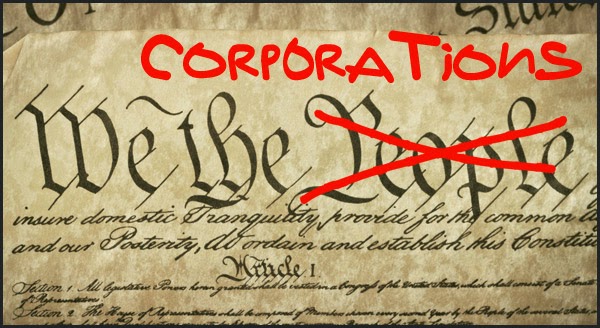
http://themoderatevoice.com/148399/the-insidiousness-of-citizens-united-the-vampire-elite-report-from-20-paws-ranch/
The Supreme Court, in a 5-4 decision, agreed with Citizens United and argued that the First Amendment provides free speech protections both to individuals and to corporations (for-profit and non-profit). The reason Citizens United could come into play in the Hobby Lobby case is because in Citizens, the Court affirmed that corporations have First Amendment rights. If for-profit corporations have their speech protected under the First Amendment, can they also seek protection from laws that would force them to violate their religious views?

I think that we may see aspects of this argument crop up here, and my expectation is that it will be used by the Hobby Lobby camp. While this decision was certainly divisive, it was strongly supported by not only the 4 conservative justices, but the opinion was written by Kennedy, who went even further in his opinion that Chief Justice Roberts originally intended.

A Supreme Court Cop-Out


As riveting as a landmark Supreme Court ruling would be, the reality is that most decisions handed down are fairly limited in scope. While it might seem like the Court could make its life easier by making a sweeping statement that clearly defines how the government should interact with religious liberty, that's not actually the purpose of the Court. The Court is to hear cases about specific events and specific laws and they are to comment on that law. Most cases that are brought before the Court are limited in scope because the situation is specific and particular. Some of the most controversial rulings are when the Court steps outside of the parameters of the case to make broad statements. This isn't to say that there aren't times when broad rulings are necessary. However, it is in our best interest as Americans to have a restrained Court that operates on a case-by-case basis instead of using cases to further some ideological goal.

All of that to say, the Court could narrowly rule in the case, which means that they could limit the ruling to a particular type of corporation or take issue with a small section of the ACA (they could even suggest a re-wording that would be constitutional).

Final Thoughts


Based on yesterday's hearings and on the information that I discussed above, my guess, my very hesitant guess, is that the Court will side with Hobby Lobby, but will do so in a limited fashion. Were the issue at stake blood transfusions or hip replacement, I think that the Court would be less likely to side with Hobby Lobby. Abortion, however, is not just any medical procedure and I think that the nature of the government mandate, along with the enormous fines imposed for non-compliance, place an undue burden on a corporation that, according to Citizens United, has religious protections under the First Amendment.

Obviously this is just a guess and there is a plethora of routes and opinions the Court can take on this particular issue. Please feel free to disagree or offer new thoughts/ideas about this case!

Sources and Recommended Reading


Hobby Lobby Contraceptive Case Goes Before Supreme Court- NPR
Religious Liberty is America's First Freedom- Rick Warren for The Washington Post
Obama Administration Suffers A Drubbing in Hobby Lobby Arguments- Forbes
Supreme Court Women Raise Questions on Contraception Coverage- Time

Wednesday, October 16, 2013

Health Insurance or a Sugar Daddy?

Full Disclosure: I am 100% opposed to the Affordable Care Act, but that does not mean that I am opposed to major healthcare reform.

I am writing this post fully acknowledging that our health care and health insurance industries are majorly flawed and that they are in need of drastic reform.  It's tragic that quality healthcare and health insurance is by and large a luxury of the middle and upper classes and that healthcare has become so unaffordable that uninsured, working class families can't even afford to take their children to routine doctor's visits or have a broken arm treated without risking their financial stability and livelihood. It's a grave problem and the problem needs a solution.

However, I think that the solution that has been proposed is not just problematic, but wholly wrong-headed and will prove to be detrimental to our entire healthcare system in the United States. I believe that it is completely possible to point out flaws and offer critiques of a system while also sympathizing, and empathizing, with those whose lives are complicated and sometimes destroyed by the deficiencies of our current system.

On to the discussion:


My problems with the Affordable Care Act are legion, but I am not going to discuss most of them here. Suffice it to say that I think that there are several parts of this law which are setting dangerous precedents for the future. One of the more troubling precedents is the way the U.S. government has placed regulations on private industry in such a way that undermines the entire business structure of that industry.

Let me explain:


The health insurance industry is an industry whose business model works because of risk. In this business relationship between the customer and the insurance company, one side is an optimist and the other is a pessimist.

I buy health insurance when I am healthy and I am betting that one day I am going to be sick. If catastrophe or sudden illness befalls me or my family, I want to know that I will have help when it matters. The insurance company is also betting on my health, but they are assuming that I will live a long, relatively healthy life.

Why does the insurance company pay for my unexpected surgery, because they entered into an agreement with me betting that I would never get sick. 

This is the way the industry works. Both sides are risking something: I may pay premiums for years and never need the insurance coverage that I have paid for, but I may also become deathly ill immediately after I sign up for coverage and the insurance company may have to pay out far more than I'll ever pay into the system with my premiums. Risk. It's what makes the insurance world go round.

Enter the Affordable Care Act:


One of the most touted aspects of the ACA is the requirement that insurance companies accept patients with pre-existing conditions. As we just saw, this new requirement undermines the structure upon which the insurance industry is built. There is no risk at all involved in the arrangement if a patient can sign up for health insurance after they've been diagnosed with a serious illness. You're not asking for insurance at that point, you're asking for a sugar daddy to pay your bills. The only reason insurance works is because insurers bet that you won't get in a car crash, that you won't die prematurely, that you won't be diagnosed with a serious illness, and for most of us, those events don't happen. However, we happily (I'm being generous) keep paying premiums and those premiums are paying for those insured who have had the diagnosis we all fear.

There is no risk involved from the customer's vantage point if they can apply for auto insurance and pay a premium only after they have rear-ended a garbage truck. They have not paid into the system. They never accepted any risk. Instead, they are expecting the insurance company to pay out for a new car. Again, that's not insurance, that's a sugar daddy.

This problem is further compounded by the regulation that forbids insurance companies to charge patients with pre-existing conditions higher premiums than they do for individuals who are and have been healthy. Insurance companies are businesses that are out to make a profit. In order for them to take on this new financial burden, insurance premiums must go up, and they must go up substantially.

Final Thoughts:


First, this requirement in no way solves the fundamental problem of health care and health insurance: that it is too expensive for average and low income families to afford. Instead, the requirement that insurance companies accept previously uninsured individuals with pre-existing conditions while not charging them higher premiums, will only drive up the cost of insurance for all.

Secondly, I believe that we have set a dangerous precedent. We have allowed the government to pass a law that fundamentally undermines the business structure of a private industry. There is no precedent for this type of action. If the government wants to argue that the health insurance industry provides a necessary service and therefore needs to fall under more stringent government regulation, that's one thing. Public utilities are subject to heavy government regulation that limits the rate of profit those companies can earn in order to control costs, but that is not what has happened here. Instead, the government has regulated the health insurance industry in such a way that it undermines its basic ability to derive a profit and provide a product at a reasonable rate.

Finally, our previous healthcare system failed many people. It failed people who were sick and laid off from their jobs, thereby losing their employer provided health insurance. It failed people who were low-income who couldn't afford to take their child to the doctor, much less afford a $500/month insurance premium. I am not functioning under the illusion that all uninsured people with pre-existing conditions chose to be uninsured. However, I am suggesting that there must be a way to provide for these individuals without potentially dismantling a private industry. I've linked to a United Liberty article below. I don't believe that it has all of the answers, but I do believe that it is an important start.


Sources and Further Reading:


Millennials are Opting Out of Obamacare Because Its Not Insurance- Forbes
Does Obamacare Reduce Costs for People With Pre-Existing Conditions?- Voices of San Diego
Replacing Obamacare: Republican Answers to Pre-Existing Conditions- United Liberty
Fixing Pre-Existing Conditions Without Obamacare- Ohio Liberty Coalition

AddThis